

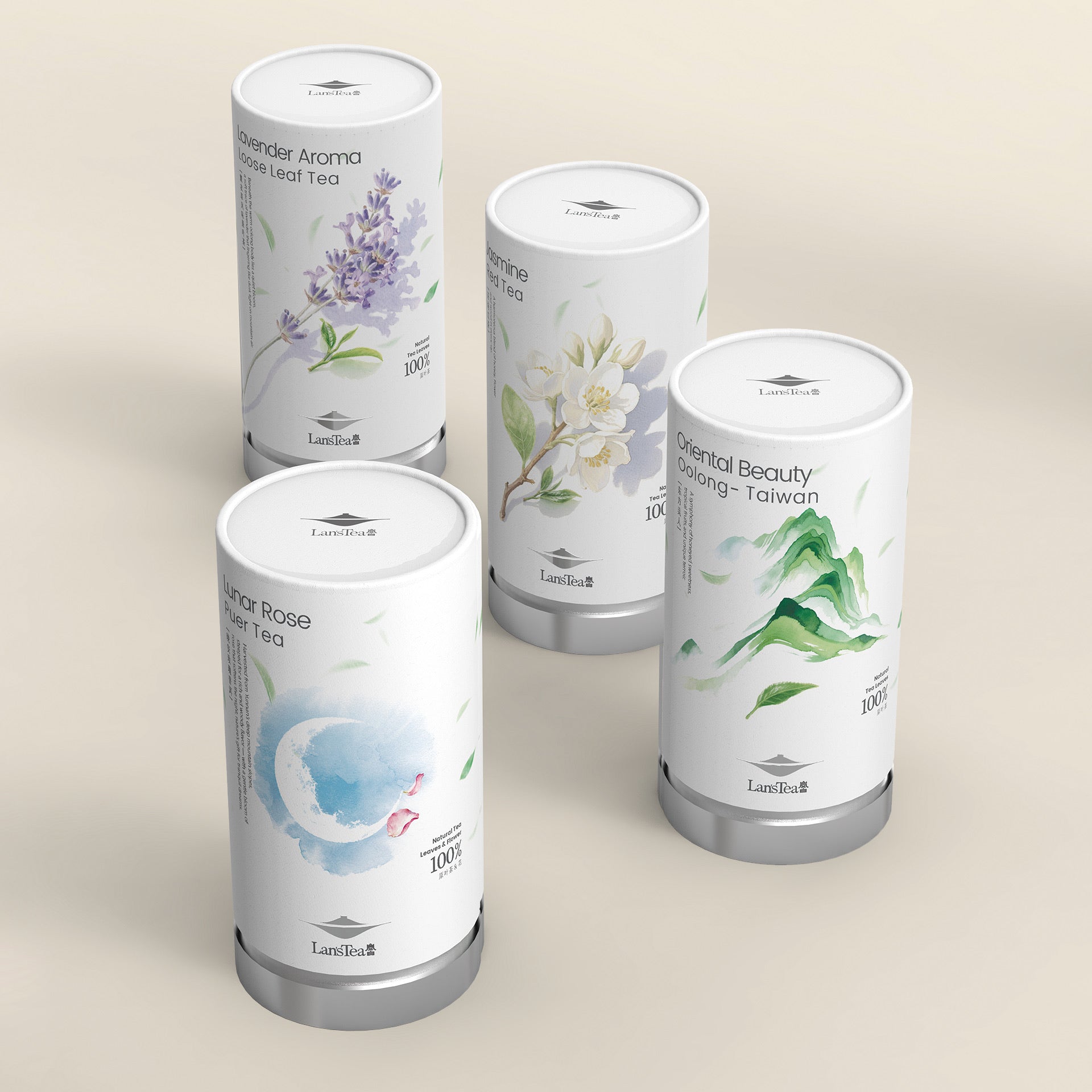


JASMINE RED TEA
Shaped by patience, fragrance, and time.
Jasmine Red Tea is crafted through a traditional scenting process in which fresh jasmine blossoms are layered with red tea leaves, allowing the aroma to infuse slowly and naturally. Repeated over multiple nights, this method creates a tea that feels soft and expressive, with floral notes that never overwhelm.
THIS IS HOW IT FEELS
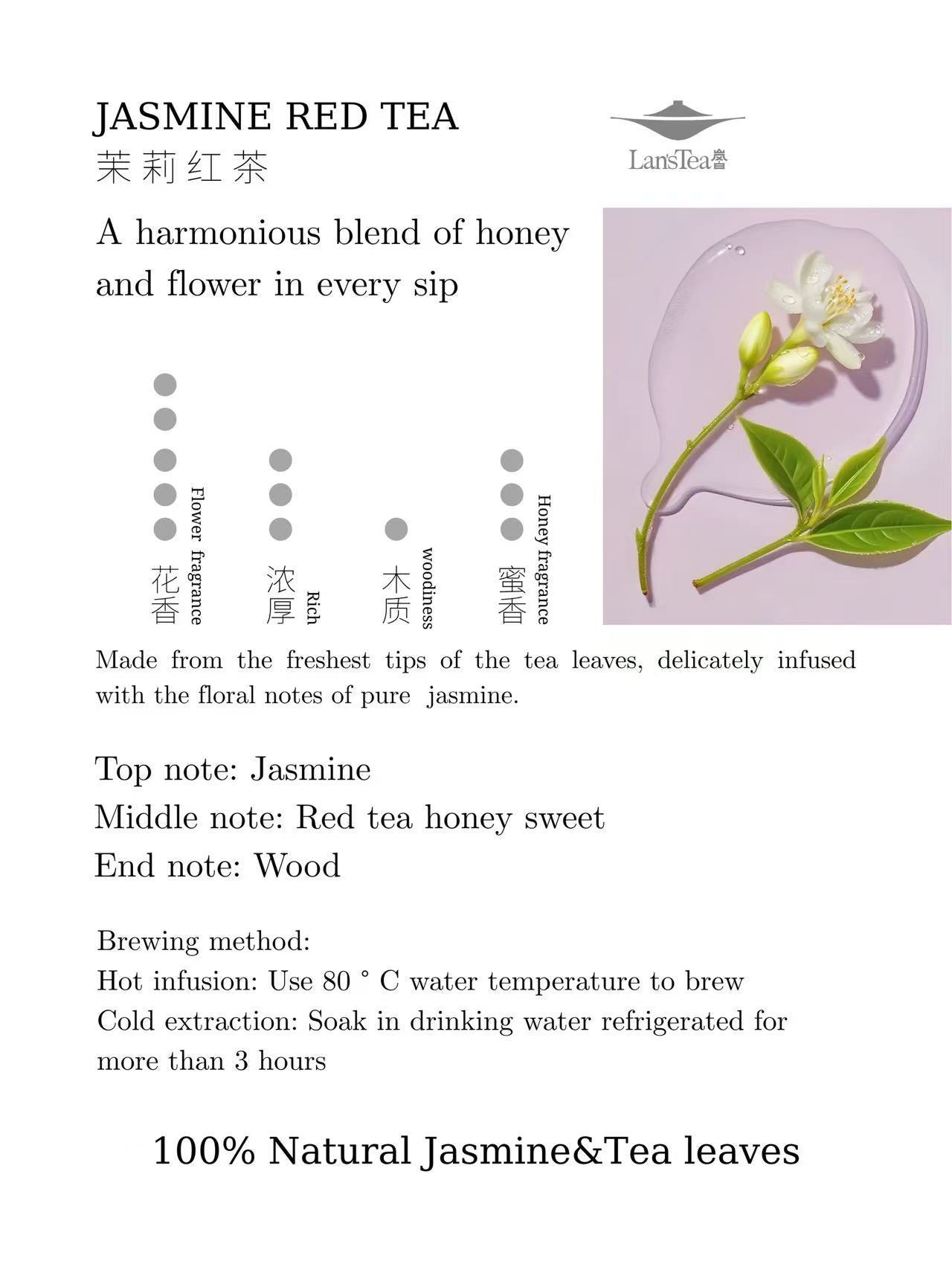
AROMA: Jasmine blossomss
PALATE : Delicate sweet & smooth
FINISH : Floral & clean
INGREDIENTS
Organic red tea scented nine times with jasmine blossoms, crafted in a centuries-old Chinese imperial tradition.


Detail
Type : Red
Variety : Moli hong luo
Region : Yunnan, China
Altitude : 1220 meters
Harvest : June, 2025
Caffeine Level : Medium
Description
Unlike the astringency of jasmine green tea, this blend offers a warm and mellow texture thanks to its red tea base. The amber-hued tea soup carries a sweet fragrance. When the rich aroma of red tea merges with the delicate scent of jasmine, wafting gently from the cup, it’s like the misty aura over a lake at dawn, softening the heart instantly.
The jasmine’s refreshing fragrance is distinct during brewing, with no trace of artificial additives. It shines particularly in cold brew—smooth and naturally sweet, making it approachable even for all tea novices. Perfect as a daily drink or a thoughtful gift.
Elige opciones


ABOUT THIS TEA
The Fuzhou area of Fujian province in China is renowned for its jasmine tea, crafted in the cool evening air perfumed by jasmine blossoms along the banks of the Min River. To create the most sophisticated jasmine teas, golden buds are carefully hand-picked during the heat of the day, while still tightly closed. As night falls, they unfurl, releasing their intoxicating fragrance, which is meticulously infused into the tea leaves. This scenting process is repeated nine times, allowing the tea leaves to absorb the blossoms’ precious essence layer by layer.
Gentle and aromatic when warm, this tea truly shines in cold brew—smooth, naturally sweet, and easy on the senses. It is especially well-suited for the quiet hours of the morning, after meditation, yoga, or moments of intentional rest, when the palate is clear and the mind is open. A tea that does not rush, but settles softly into the rhythm of everyday life.
Scenting tea nine times requires time, restraint, and an uncommon level of care—a process few producers are willing to undertake today. This is not a tea made for speed or mass production, but one created for those who value clarity, balance, and intention. Jasmine Red Tea is a quiet luxury, meant to be enjoyed slowly by those who understand that true refinement is felt, not announced.
YOUR FAQS WITH ANSWERED
FOR JASMINE RED TEA
We refer to this as "red tea" to distinguish it from the commonly known British "black tea" internationally. There are significant differences in production techniques and flavors between Chinese red tea (especially Yunnan red tea) and British black tea: Chinese red tea undergoes traditional full fermentation, resulting in a bright amber (reddish-toned) tea soup with a warm, mellow taste and rich, layered aromas. In contrast, British black tea undergoes a higher degree of fermentation, yielding a darker brown tea soup with a robust flavor, often suited for mixing with milk.
Using "red tea" not only aligns with the characteristics of Chinese red tea's soup color and taste but also aims to help everyone intuitively perceive this unique tea charm from China, understanding its distinct appeal compared to the more familiar black tea.
The scenting process of our Jasmine Red Tea is an exquisite interplay of time,craftsmanship, and nature’s bounty, with every step dedicated to pursuing the ultimate flavor.
We select premium red tea leaves and fresh jasmine flowers as raw materials, laying a solid foundation for quality from the very start. Jasmine buds are picked when they are on the verge of blooming, at which point they hold the most concentrated fragrance. As night falls, when the flowers naturally open and their aroma reaches its peak, the crucial moment of scenting arrives—tea leaves and flowers are layered alternately in a 1:1 golden ratio, allowing the dry tea leaves to fully absorb the floral essence.
This is no one-time process: after each round of scenting, the old flowers must be carefully removed and replaced with newly bloomed ones, and this cycle repeats. More rounds of scenting result in a richer, more lingering aroma, but they also demand exponentially more flowers, time, and labor, driving up the cost. Throughout, tea masters must precisely control the blooming degree of the flowers, the duration of mixing, the ambient temperature and humidity, and even the thickness of the tea and flower layers. A slight deviation in any detail could compromise the final aroma and taste.
Once all scenting procedures are completed, a "flower separation" step follows, thoroughly separating the tea leaves from the flowers—what ultimately reaches you is a pure tea product where only the fragrance of flowers lingers, with no trace of the blooms themselves.
It is thanks to such intricate and refined craftsmanship that when you open the package, the rich aroma of red tea and the delicate scent of jasmine intertwine and greet you. When brewed, the fragrance slowly diffuses from the cup, as if capturing the moment when night-blooming jasmine meets sun-dried red tea. Upon sipping, the mellow tea soup carries the dual aromas, unfolding gently on your palate—every note tells the story of this balance between nature and craftsmanship.
We recommend 2–3 grams per cup (about 1 teaspoon).
For a stronger flavor, you may increase slightly to 4 -5 grams.
Red teas should be steeped for 2-3 minutes at a temperature of 185°F or 85°C.
Yes.The red tea can be gently re-steeped up to five times,with the jasmine softening beautifully.